For additional information relating to this article, please contact:
June 23, 2021STUDY: INTERNATIONAL STUDENTS AS A SOURCE OF LABOUR SUPPLY: RETENTION IN THEIR PROVINCE OF STUDY Today, Statistics Canada released six economic and social reports. The following is a summary of International students as a source of labour supply: Retention in their province of study. This study is a part of series that provides a broad overview of international students as a source of labour supply in Canada. The authors integrated data from the Postsecondary Student Information System (PSIS) and T1 Family File (T1FF) to examine the retention rate of international students who completed their studies between 2010 and 2016. Domestic graduates were used as a point of reference. In this study, a sample of 2.2 million domestic graduates and 0.2 million international graduates was used.
The population of graduates is grouped into three categories, stay (province of residence same as province of study in tax return), Move / Not stated (province of residence different from province of study or not stated in tax return) and Absent from tax data (no record available in the T1FF data).
The share of graduates staying in their province of study was higher for domestic students compared with international students for both one year after and five year after graduation. This difference could be accounted for departure of many international students from Canada. Overall, around one in two international student graduates remained in their province of study one year after graduation; this percentage falls to under 36% five years after graduation.
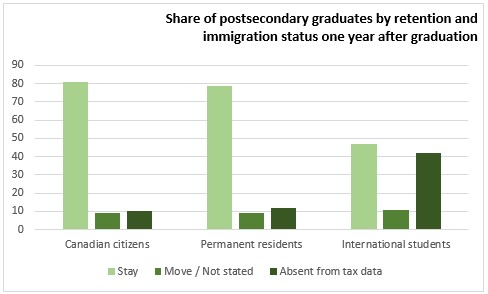
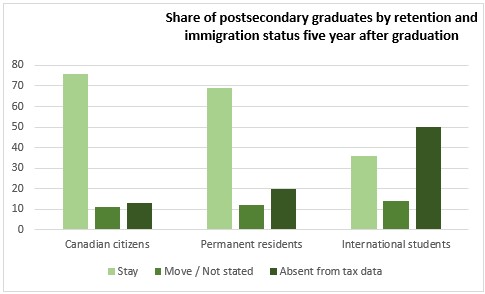
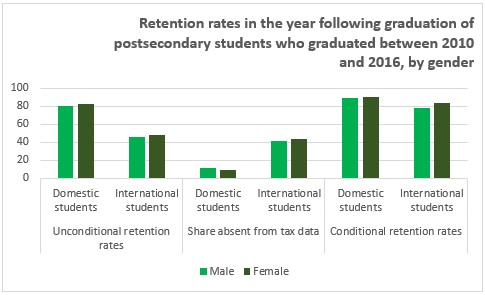
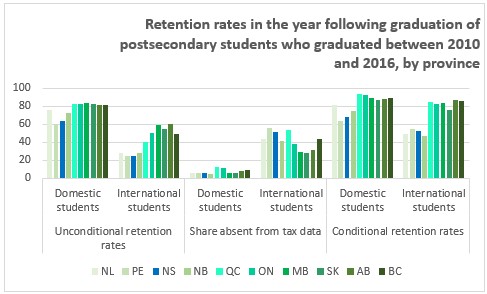
The study computed two types of retention rates based on retention status. Unconditional retention rate which is defined as the proportion of postsecondary students staying in their province of study after graduation regardless of whether they are present in tax data. Being absence from the tax data likely indicates having left Canada after graduation – particularly for international students. The Conditional retention rate is defined as the proportion of graduates who are present in the tax data (thus persons who are present in Canada) and who also stay in their province of study.
Retention rates were modestly higher among women than men for both domestic and international students.
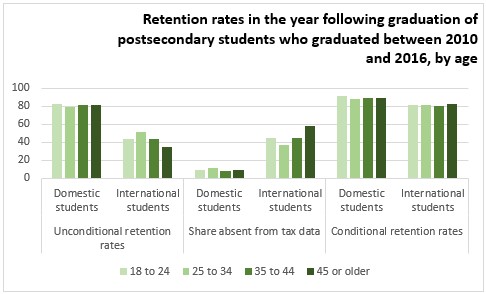
Unconditional retention rates were lower among all age groups of international graduates compared to domestic graduates. The share absent from tax data was higher among all age groups of international students than domestic students. Conditional retention rates were similar among all age groups of both international and domestic graduates.
The study suggests that first year retention rates of international graduates varied by sociodemographic and educational characteristics. Among all international graduates, 40% of graduates with a bachelor’s degree and 36% of graduates with a doctoral degree stayed in their province of the study while 58% of graduates with a college diploma stayed in their province of the study.
Among different fields of study, international graduates of personal, protective and transportation services programs were the most likely to stay in their province of study, followed by those graduating from programs in architecture, engineering, and related technologies, mathematics, computer and information sciences and health and related fields.
International graduates of humanities, social and behavioural sciences and law, and physical and life sciences and technologies were least likely to stay.
Unconditional retention rates were lower in Atlantic provinces for both international and domestic graduates during 2010-2016. Unconditional retention rates of international graduates were higher in Alberta and Manitoba. Conditional retention rates were also lower in Atlantic provinces and higher in Alberta and British Columbia.
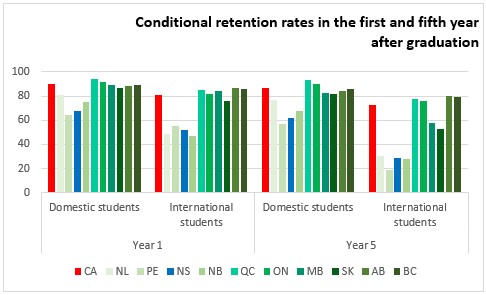
The study suggests that around 8 in 10 international students present in the tax data (living in Canada) remained in their province of study one year after graduation compared with around 9 in 10 domestic students. The conditional rate declined to 7 in 10 five years after graduation. First year conditional rates of domestic graduates were lower in Atlantic provinces and higher in Quebec and Ontario. Despite the conditional retention rates declined in five years after graduation, the pattern among provinces remained same.
First year conditional retention rates of international graduates were lowest in Atlantic provinces and highest in Alberta and Quebec. The largest gaps between retention rates between domestic and international graduates were reported in Newfoundland and Labrador and New Brunswick.
Fifth year conditional retention rates of both domestic and international graduates declined and the decline in retention rates were larger for international graduates especially for those who studied in the Atlantic provinces, Saskatchewan, and Manitoba. The conditional retention rates were highest in Alberta and British Columbia for international graduates.
Source: Statistics Canada International students as a source of labour supply: Retention in their province of study