For additional information relating to this article, please contact:
December 05, 2025LABOUR MARKET TRENDS, NOVEMBER 2025 November labour force survey results reflect the period from November 9 to 15, 2025.
Ages 15+ (November 2025 vs October 2025, seasonally adjusted)
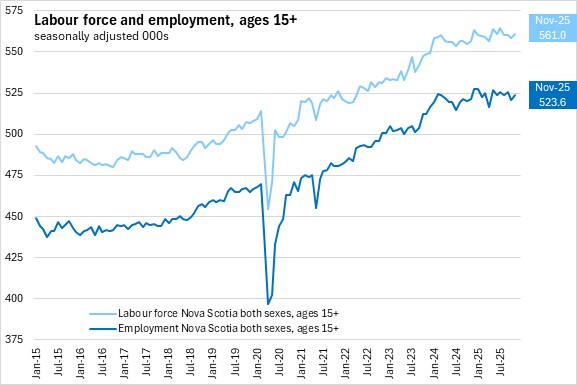
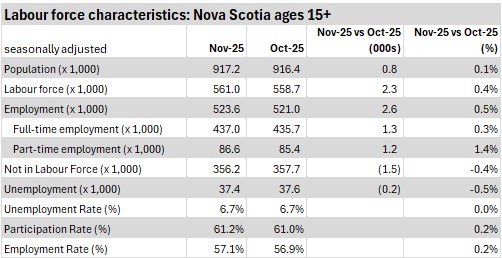
Nova Scotia's seasonally adjusted employment grew 2,600 (+0.5%) to 523,600 in November, following a decline of 4,400 (-0.8%) in the previous month.
The change in employment reflected an increase for full-time (+1,300) as well as in part-time (+1,200) employment. Note that changes in full-time and part-time employment can also reflect changing hours for the same job.
Nova Scotia’s labour force increased by 2,300 (+0.4%) to 561,000 in November 2025.
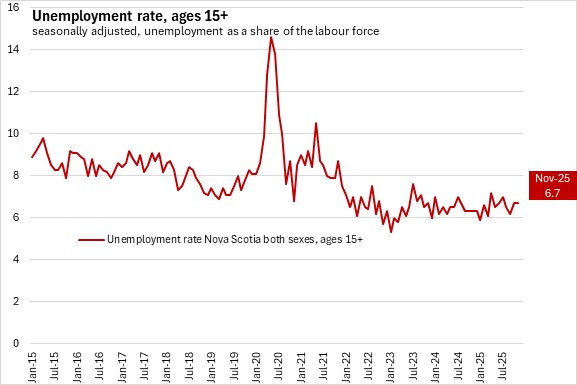
With employment and labour force rising at similar pace, Nova Scotia's unemployment rate remained unchanged at 6.7% in November 2025.
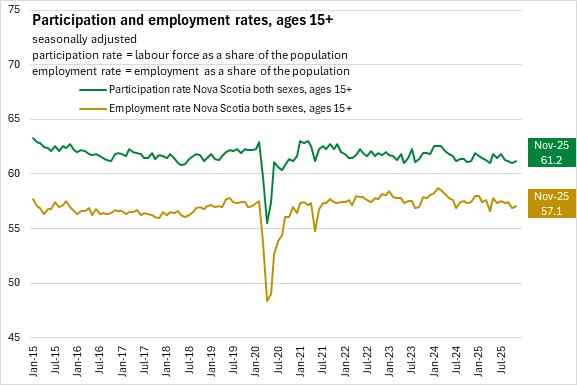
Nova Scotia's labour force participation rate edged up 0.2 percentage points to 61.2% while the employment rate increased 0.2 percentage points to 57.1% in November 2025.
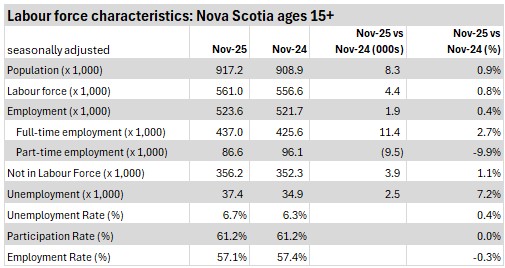
Ages 15+ (November 2025 vs November 2024, seasonally adjusted)
Compared with November 2024, Nova Scotia's population over the age of 15 increased by 8,300 (+0.9%), while the labour force increased 4,400 (+0.8%), and employment increased by 1,900 (+0.4%). Compared to November 2024, the unemployment rate was up by 0.4 percentage points, while the participation rate was unchanged and the employment rate declined by 0.3 percentage points.
Ages 15+ (January-November 2025 vs January-November 2024, seasonally adjusted)
Compared with the first eleven months of 2024, Nova Scotia's population over the age of 15 increased by 12,000 (+1.3%), while the labour force grew by 3,700 (+0.7%), and employment increased by 3,000 (+0.6%). The unemployment rate edged up 0.1 percentage point, while the participation rate and the employment rate both fell by 0.4 percentage points.
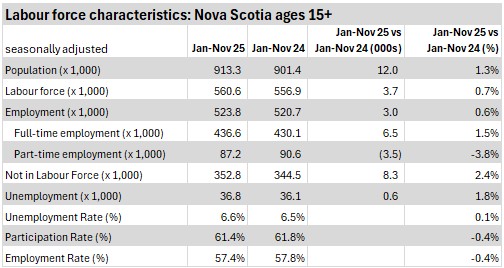
Note: Year-to-date estimates are calculated as averages of monthly data and rounded to the nearest tenth. Year-to-date changes in the table are also rounded to the nearest tenth.
Age Cohorts (November 2025 vs October 2025, seasonally adjusted)
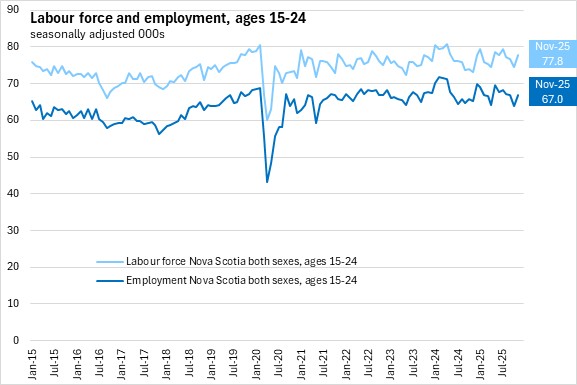
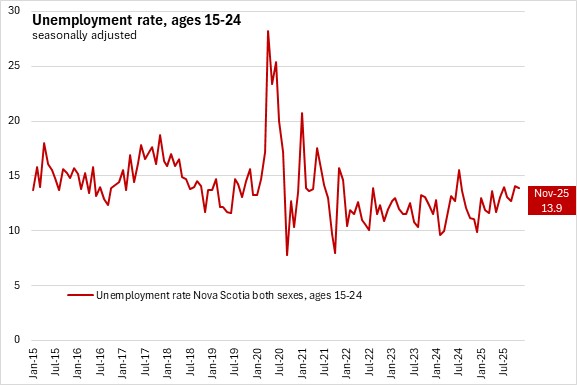
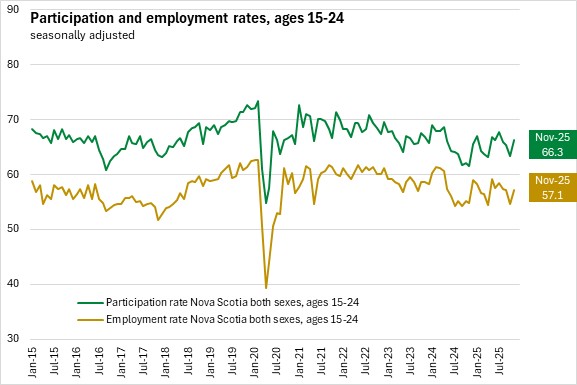
Among youth (ages 15-24), employment grew by 3,000 (+4.7%) while the labour force increased by 3,400 (+4.6%). The youth unemployment rate fell 0.2 percentage points to 13.9% in November 2025. The youth participation rate increased 2.9 percentage points to 66.3% while the youth employment rate increased 2.5 percentage points to 57.1%.
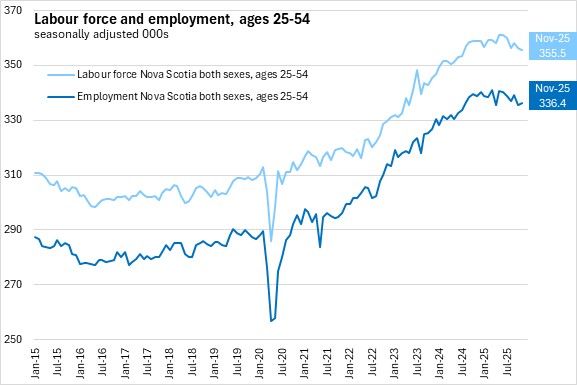
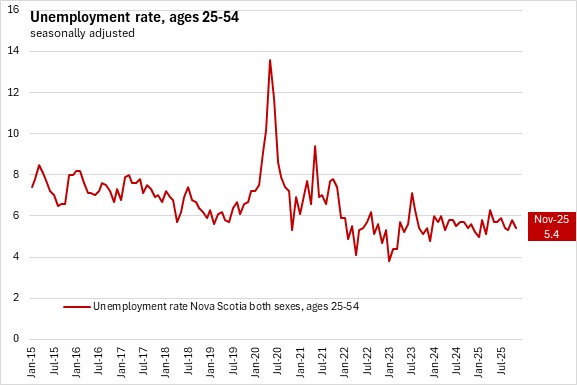
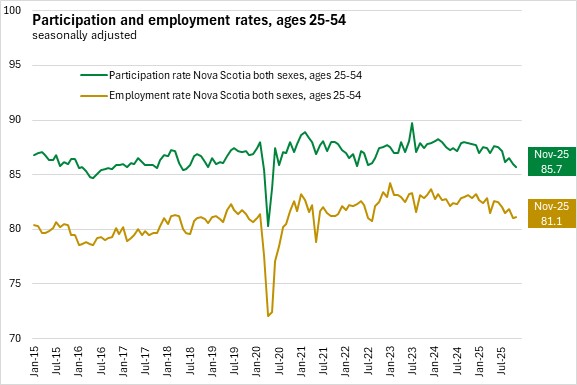
The population aged 25-54 makes up the largest part of the labour force. In the core age group, employment grew by 700 (+0.2%) while the labour force declined by 800 (-0.2%). With employment rising and the labour force falling, the core aged unemployment rate declined 0.4 percentage point to 5.4% in November 2025. The core aged participation rate declined 0.3 percentage point to 85.7%, while the core aged employment rate edged up 0.1 percentage point to 81.1%.
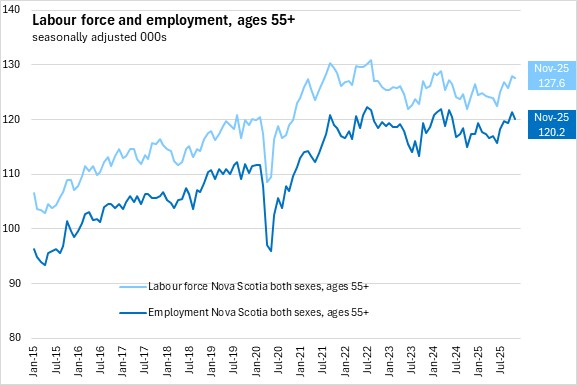
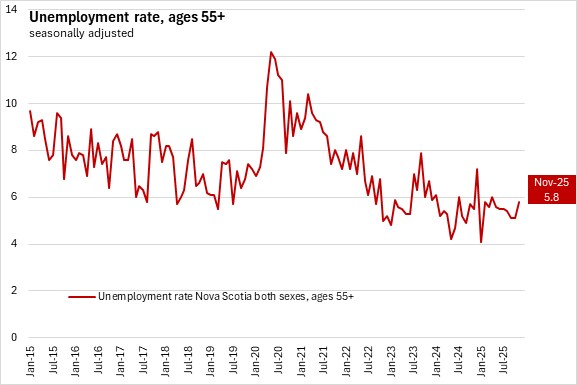
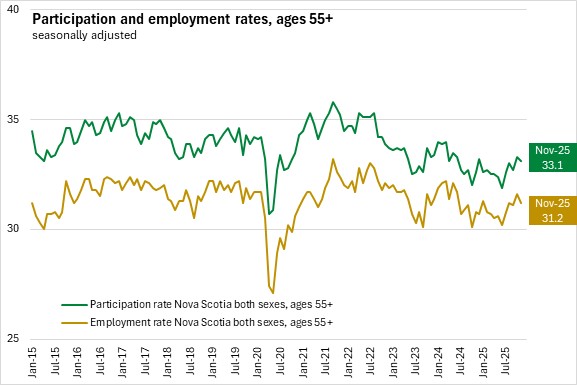
Among older workers (aged 55+) the labour force decreased by 300 (-0.2%) while employment fell 1,200 (-1.0%). With employment declining more than labour force, the older worker unemployment rate increased 0.7 percentage points to 5.8%. The older worker participation rate fell 0.2 percentage points to 33.1% and the employment rate for older workers fell 0.4 percentage points to 31.2%.
Males and Females (Ages 15+, October 2025 vs September 2025, seasonally adjusted)
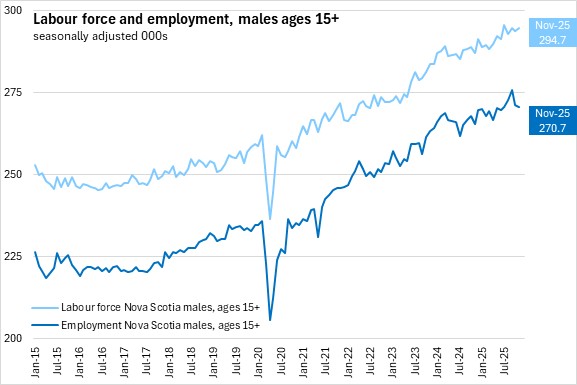
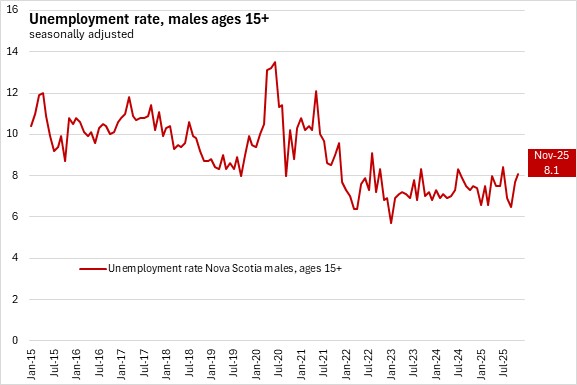
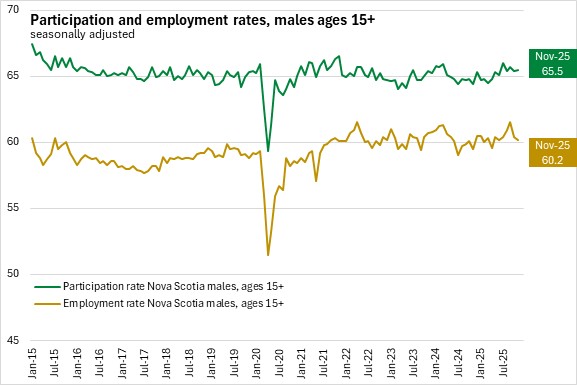
Monthly employment decreased by 600 (-0.2%) for males while the labour force increased by 900 (+0.3%) from October. With employment declining and rising labour force, the male unemployment rate increased by 0.4 percentage points to 8.1% in November. The male participation rate edged up 0.1 percentage point to 65.5%, while the male employment rate fell 0.2 percentage points to 60.2%.
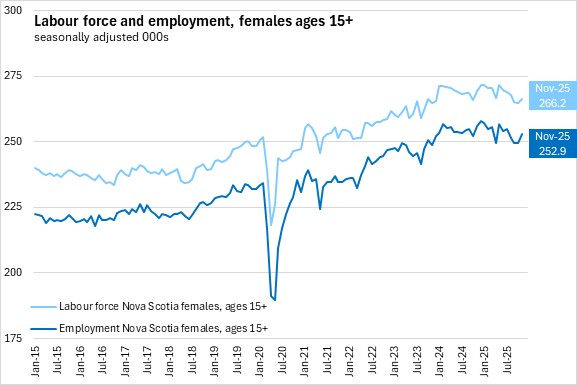
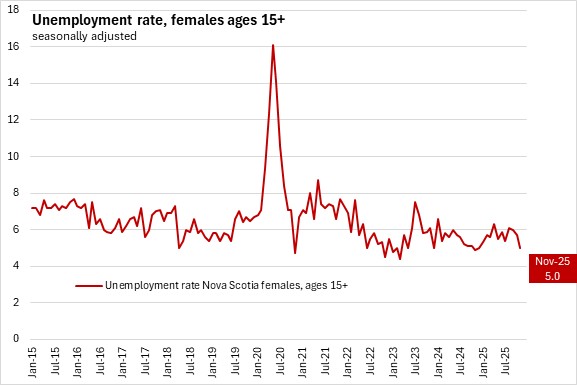
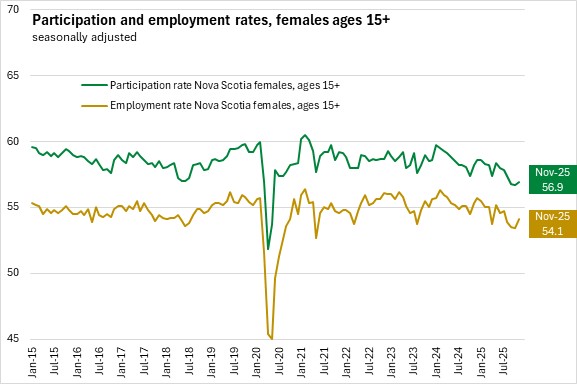
Females reported an employment increase of 3,200 (+1.3%) and a labour force gain of 1,300 (+0.5%). With employment rising faster than the labour force, the female unemployment rate declined by 0.7 percentage points to 5.0% in November. The female participation rate increased by 0.2 percentage point to 56.9% and the female employment rate grew by 0.7 percentage point to 54.1%.
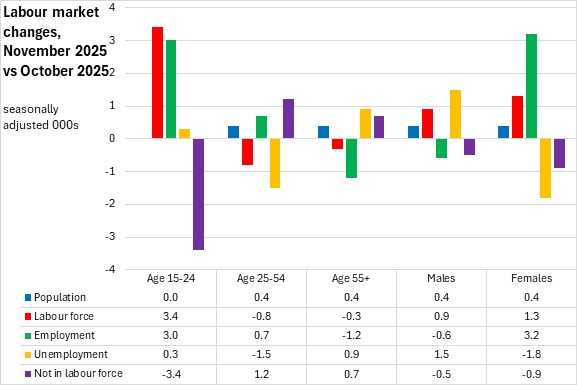
November employment gain was concentrated among youth, core-aged workers and females, partially offset by lower employment for older workers and males. Core-aged workers, and females reported employment gains that outpaced the labour force, resulting in lower unemployed among these age cohorts and a lower number of people not in the labour force among females. Labour force growth outpaced employment growth for youth, resulting in more unemployed and fewer not in the labour force. Males reported a decline in employment and a rise in labour force resulting an increase in unemployment and fewer not in the labour force.
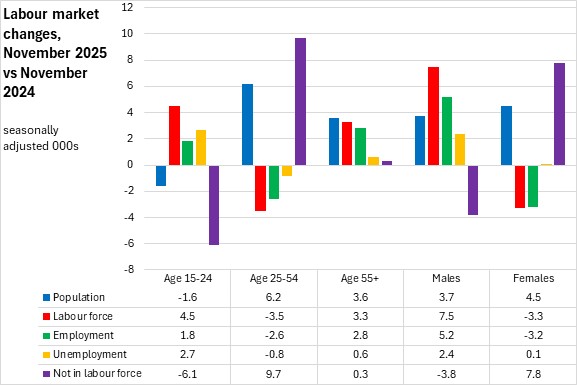
Age and gender cohorts (November 2025 vs November 2024, seasonally adjusted)
Compared with November 2024, labour force and employment growth was concentrated among youth, older workers and males. Core-aged workers, and females reported lower employment and labour force. Core-aged workers reported a notable increase in population and those not in the labour force. Youth reported stronger labour force growth outpacing weaker employment growth. Youth were the only age cohort to report population decline. Males reported higher unemployment and fewer males not in the labour force. Females labour force and employment fell, with increases in population, unemployment, and females not in the labour force.
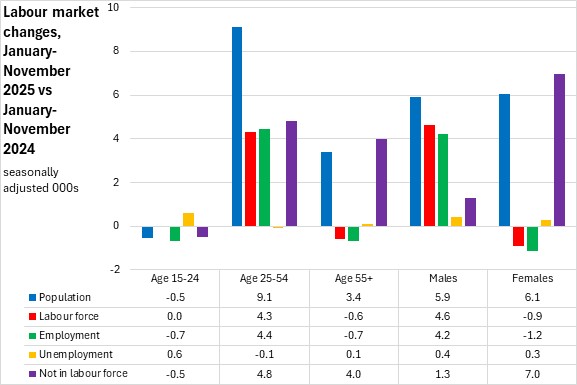
Age and gender cohorts (January-November 2025 vs January-November 2024, seasonally adjusted)
Compared with January-November 2024, labour force and employment growth was concentrated among core-aged workers (whose population is also growing more than others). Employment grew about the same pace as labour force for core-aged workers, with a slight decline in unemployment. Youth reported employment declines with unchanged labour force while older workers employment and labour force declined at the same pace. Unemployment increased for youth while it increased marginally for older age cohorts, as well as both genders. Males reported growth in labour force that slightly outpaced employment, resulting in marginally higher unemployment. Females reported an employment decline that outpaced labour force decline, generating an increase among females unemployed. The number of females not in the labour force increased faster than the number of males not in the labour force, despite similar increases in population.
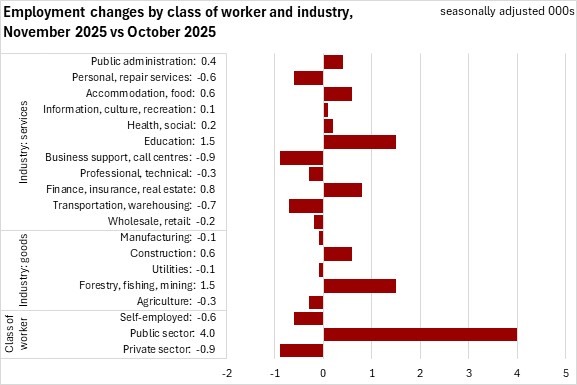
Class of Worker and Industry (November 2025 vs October 2025, seasonally adjusted)
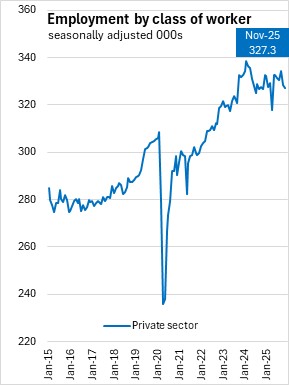
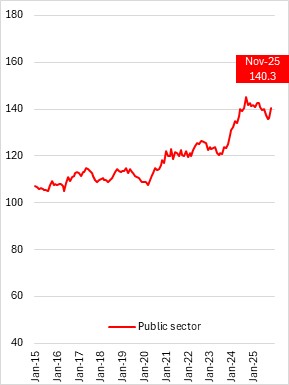
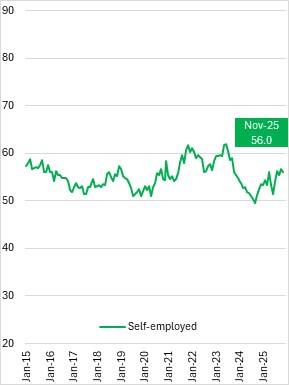
Employment gain in November was due to growth for public sector (+4,000, +2.9%), partially offset by a lower number of private sector workers (-900, -0.3%), and self-employed (-600, -1.1%).
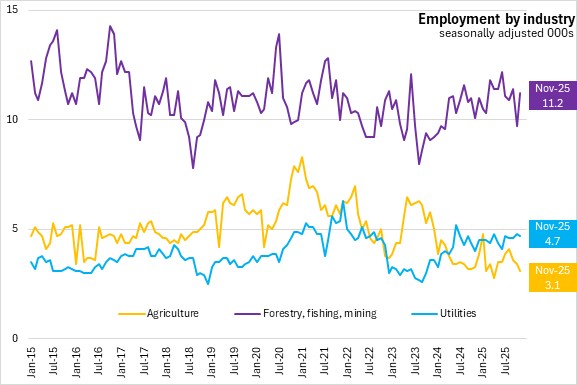
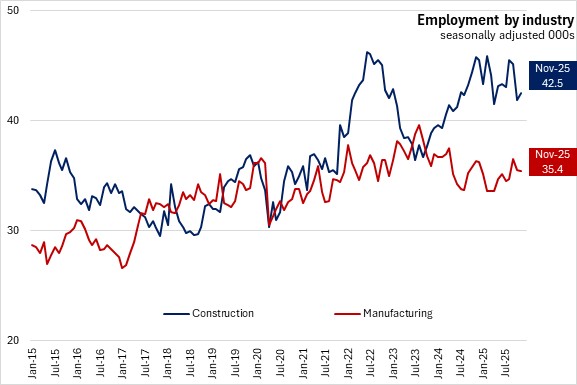
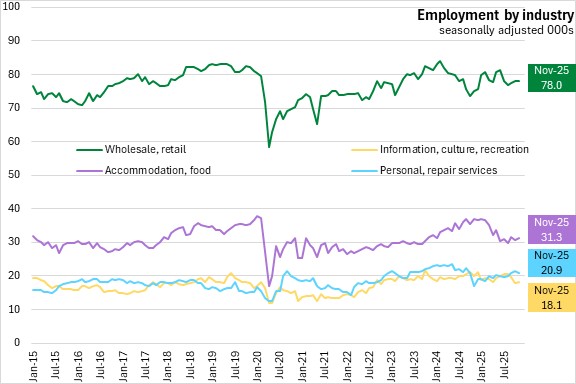
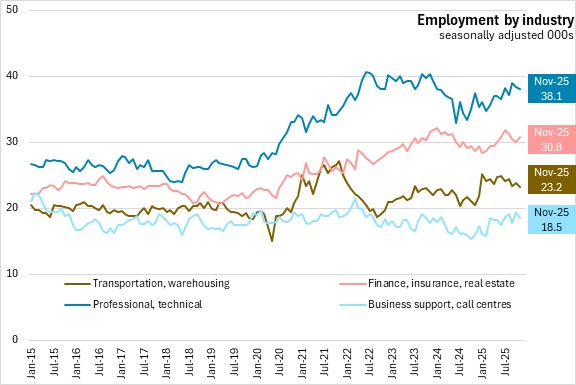
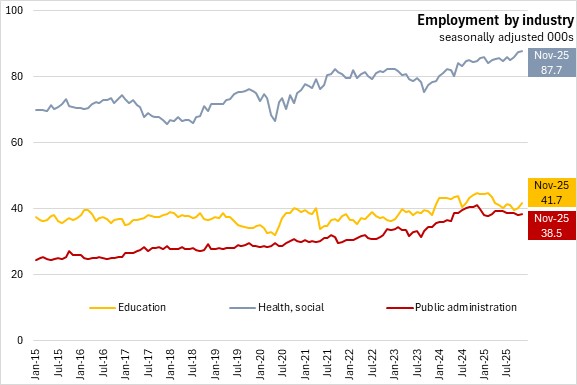
Classified by industry, the largest growth was among forestry/fishing/mining and education. The largest declines in November were reported in business support/call centres, transportation/warehousing, and personal/repair services.
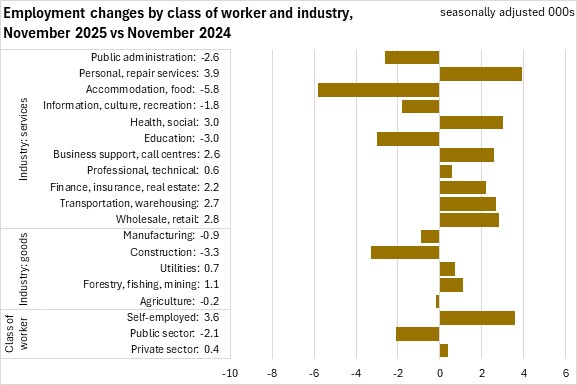
Class of Worker and Industry (November 2025 vs November 2024, seasonally adjusted)
Compared to November 2024, there were employment gains for private sector workers (+400, +0.1%), and self-employment (+3,600, +6.9%), while public sector employment declined (-2,100, -1.5%).
Over the last 12 months, employment grew the most in personal/repair services and health/social assistance. Employment declined the most in accommodation/food services, followed by construction.
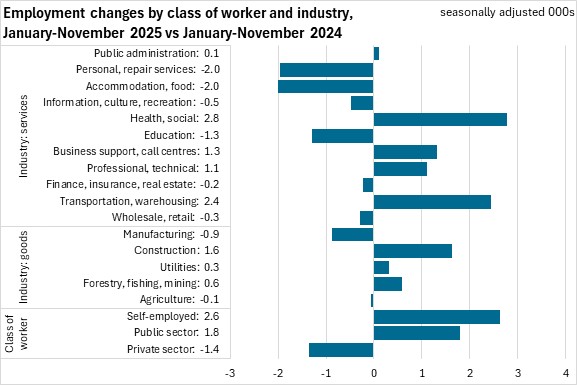
Class of Worker and Industry (January-November 2025 vs January-November 2024, seasonally adjusted)
Compared to January-November 2024, gains were strongest for self employment (+2,600, +5.1%), with smaller gains in public sector workers (+1,800, +1.3%). There was a decline in private sector workers (-1,400, -0.4%).
Gains in employment were strongest in health care/social assistance, transportation/warehousing, and construction. The largest declines were in personal/repair services, accommodation/food services, and education.

Hours worked and employment (November 2025, unadjusted)
Compared to the provincial average, a larger share of workers in goods producing industries, transportation/warehousing, information/culture/recreation, accommodation/food services, business support/call centres, and public administration worked more than 40 hours per week in November 2025.
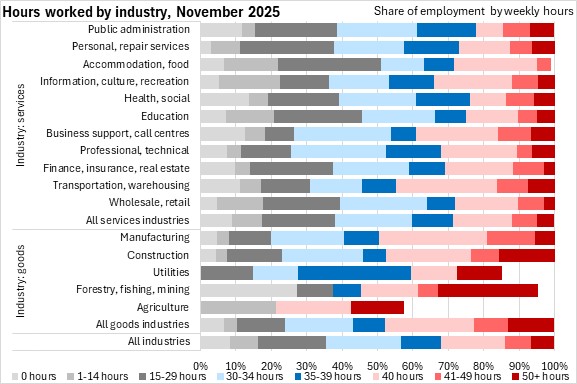
Note that some data on those working few hours in utilities, forestry/fishing/mining and agriculture were suppressed.
Average weekly earnings (unadjusted, both full time and part time, November 2025 vs November 2024)
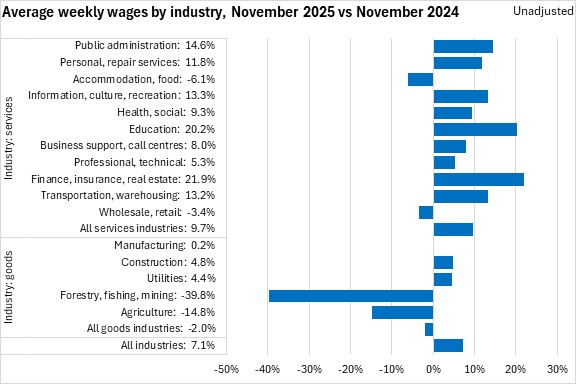
Average weekly earnings increased by 7.1% from November 2024 to November 2025. The fastest gains in average weekly earnings were in finance/insurance/real estate, education, and public administration. The largest declines in average weekly wages were in forestry/fishing/mining, followed by agriculture.
The increase in Nova Scotia's all items consumer price index was 2.6% from October 2024 to October 2025.
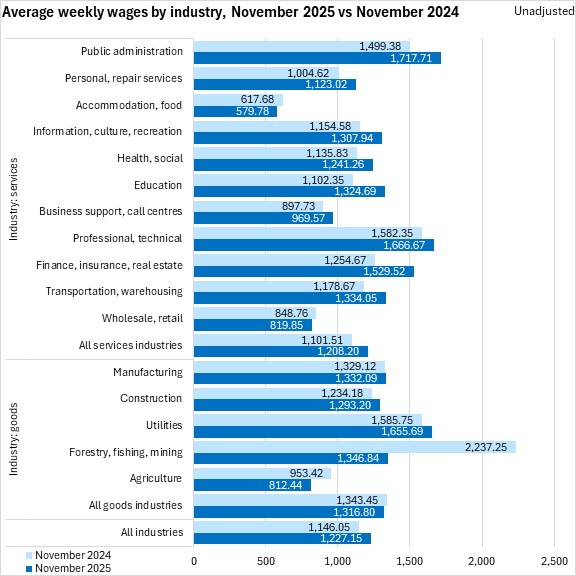
Average weekly earnings across all employees were $1,227.15 in November 2025. The highest average weekly earnings (both full and part time employees) were reported in public administration, professional/technical services, and utilities. The lowest average weekly earnings were in accommodation/food services, agriculture, and wholesale/retail trade.
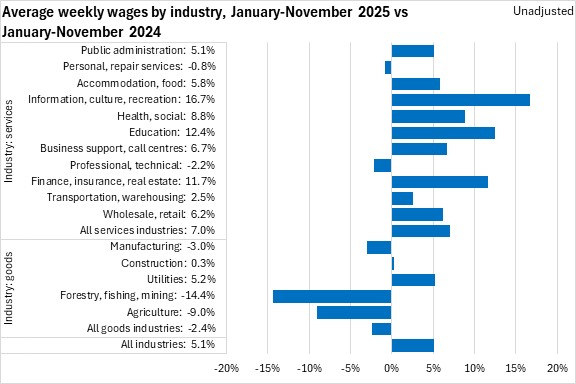
Average weekly earnings (unadjusted, both full time and part time, January-November 2025 vs January-November 2024)
Average weekly earnings increased 5.1% in the first eleven months of 2025 compared to the same period of 2024. The fastest gains in average weekly earnings were in information/culture/recreation, education, and finance/insurance/real estate. Agriculture and forestry/fishing/mining reported the fastest declines in average weekly earnings in January-November 2025.
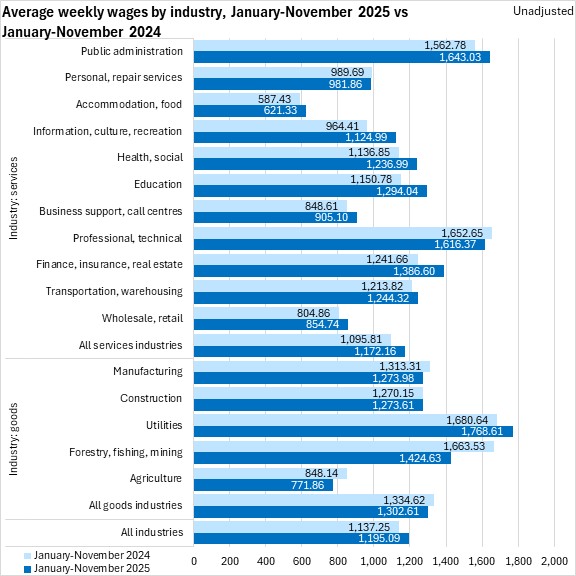
Average weekly earnings in the first eleven months of 2025 were highest in utilities, public administration, and professional/technical services. The lowest average weekly earnings were in accommodation/food services, and agriculture in January-November 2025.
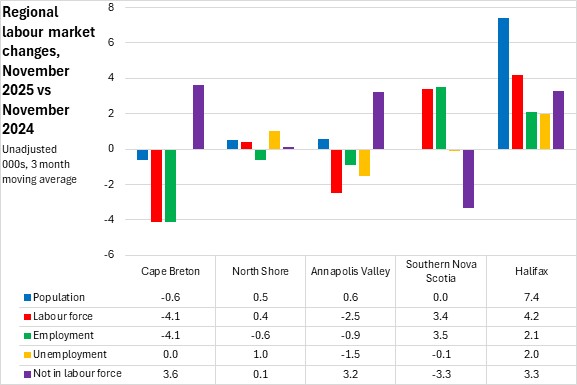
Regions (November 2025 vs November 2024, unadjusted 3 month moving average)
Compared with November 2024, labour force and employment growth was concentrated in Halifax and Southern Nova Scotia. Southern Nova Scotia reported employment growth that outpaced labour force growth, with fewer persons among the unemployed and not in the labour force. North Shore region reported an increase in labour force but a decline in employment compared to one year ago, translating into higher unemployment. Cape Breton reported lower population, labour force and employment, with no change in unemployment and a rise in those not in the labour force. The Annapolis Valley region reported declines in labour force that outpaced employment decline and a notable rise in those not in the labour force.
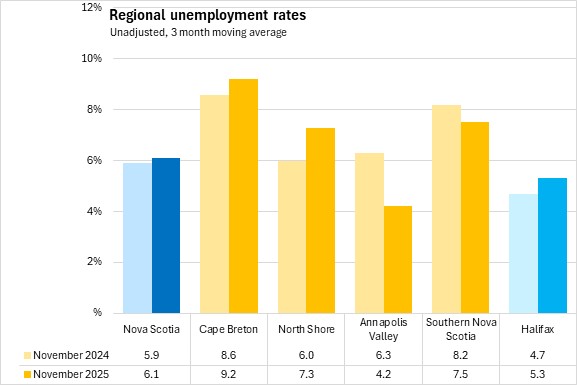
Unemployment rates declined in Annapolis Valley and Southern Nova Scotia compared to November 2024. The unemployment rates in Cape Breton, North Shore and Halifax rose compared to one year ago.
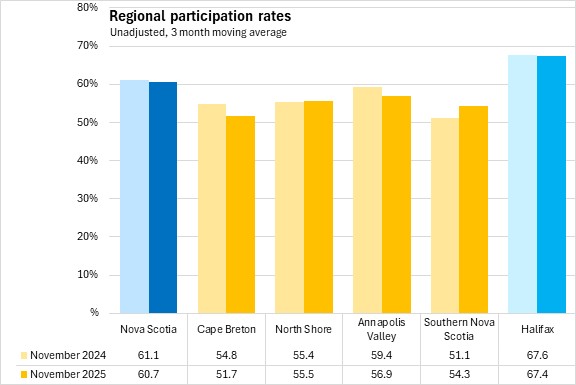
Participation rates declined in all regions except North Shore and Southern Nova Scotia.
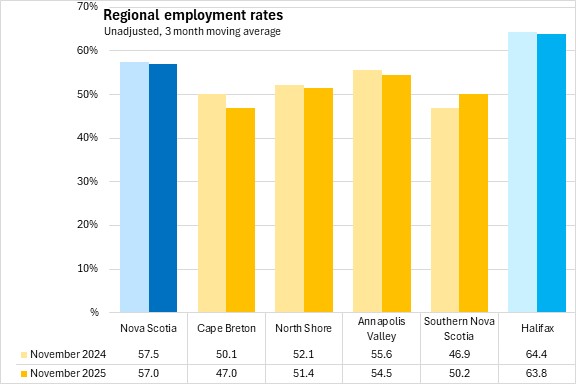
Employment rates were down compared to one year ago across all regions except Southern Nova Scotia.
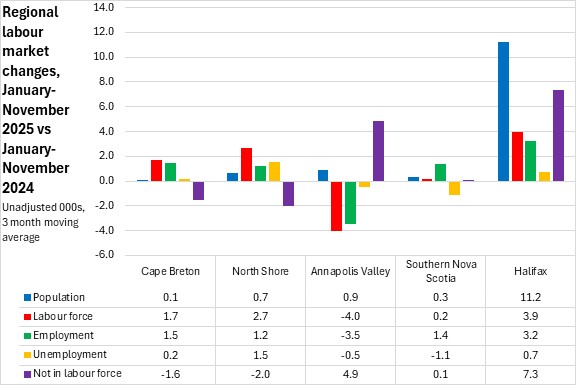
Regions (January-November 2025 vs January-November 2024, unadjusted 3 month moving average)
Compared with January-November 2024, labour force and employment increases were concentrated in Cape Breton, the North Shore, and Halifax, all of which reported stronger growth in labour force than employment, resulting in higher unemployment. Lower labour force and employment in the Annapolis Valley resulted in more people not in the labour force. Southern Nova Scotia reported a higher employment on a smaller labour force gain, resulting in fewer unemployed and a higher number of persons not in the labour force. Halifax saw the strongest population growth, and a large increase in the number of people not in the labour force.
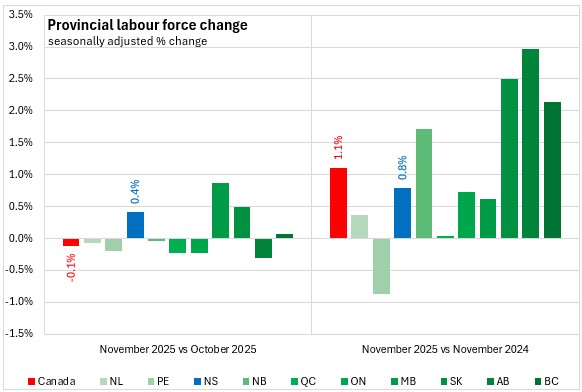
Provincial Comparisons (seasonally adjusted)
Canada's labour force was down 0.1% from October with six provinces reporting declines in November 2025. The fastest growth was in Manitoba, while the fastest decline was in Alberta.
Compared with November 2024, the national labour force was up 1.1%, with every province except Prince Edward Island reporting growth. Alberta reported the fastest increase.
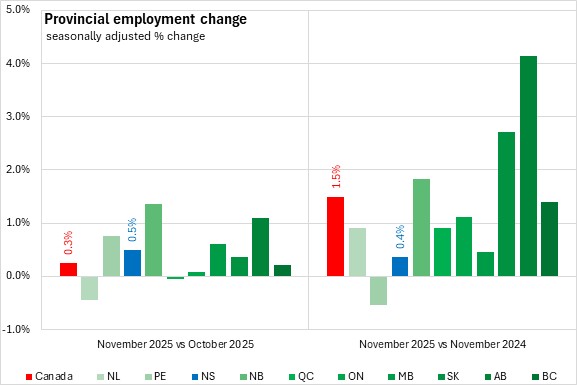
Canada's employment increased by 0.3% in November 2025. Eight provinces reported higher employment in November led by New Brunswick. Newfoundland and Labrador reported the fastest decline compared to October.
Compared with November 2024, the national employment gain was 1.5% with all provinces reporting growth except Prince Edward Island. The fastest growth was in Alberta.
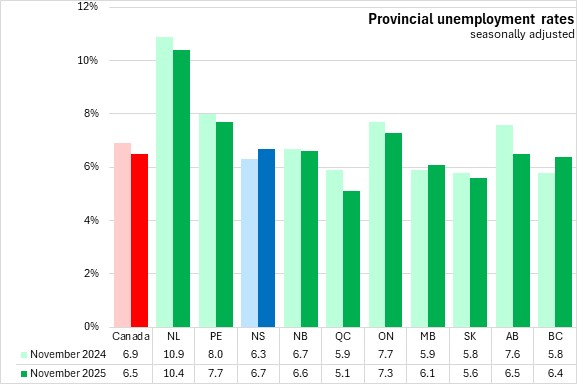
The national unemployment rate was 6.5% in November 2025, down from 6.9% in November 2024. Québec had the lowest unemployment rate while Newfoundland and Labrador reported the highest unemployment rate in November 2025.
The national participation rate was 65.1% in November 2025. The highest participation rate was in Alberta while the lowest was in Newfoundland and Labrador.
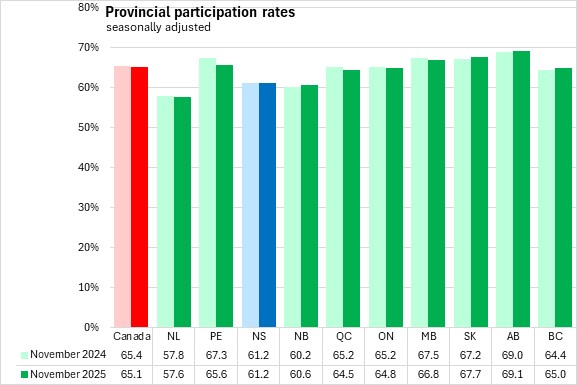
The national employment rate was 60.9% in November 2025. Alberta and Saskatchewan reported the highest employment rate while Newfoundland and Labrador reported the lowest.
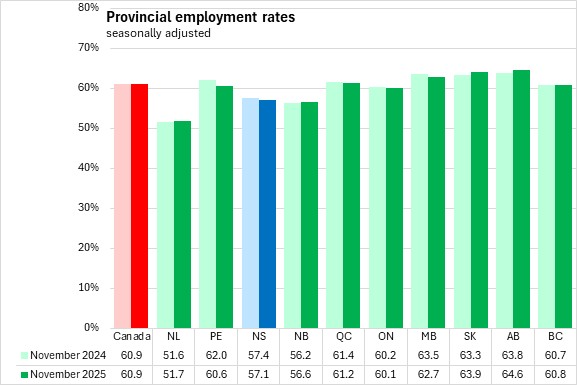
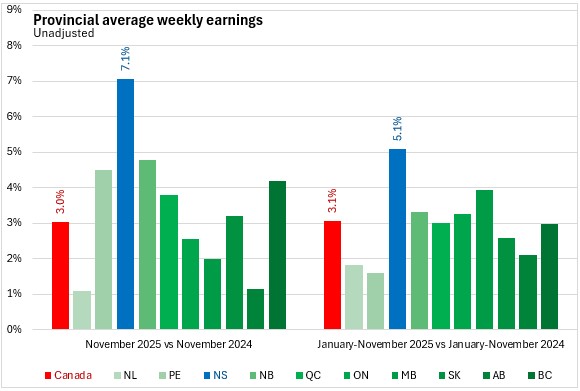
In unadjusted results, Nova Scotia's average weekly earnings grew by 7.1% year-over-year, the fastest gain among provinces. National average weekly earnings were up 3.0% with the slowest growth in Newfoundland and Labrador and Alberta.
Comparing January-November 2025 with the same months in 2024, Nova Scotia's average weekly earnings were up 5.1% - fastest among provinces. National average weekly earnings were up 3.1% year-to-date with the slowest growth in Prince Edward Island.
Census Metropolitan Areas (November 2025, seasonally adjusted 3 month moving average)
The Halifax & East Hants unemployment rate was 5.7% in the seasonally adjusted November 2025 three month moving average. Outside of Halifax & East Hants the unemployment rate was 7.6%. In central and western provinces, unemployment rates in Census Metropolitan Areas are similar to or higher than unemployment rates outside of CMAs. In the Atlantic Provinces unemployment rates are typically higher outside of CMAs.
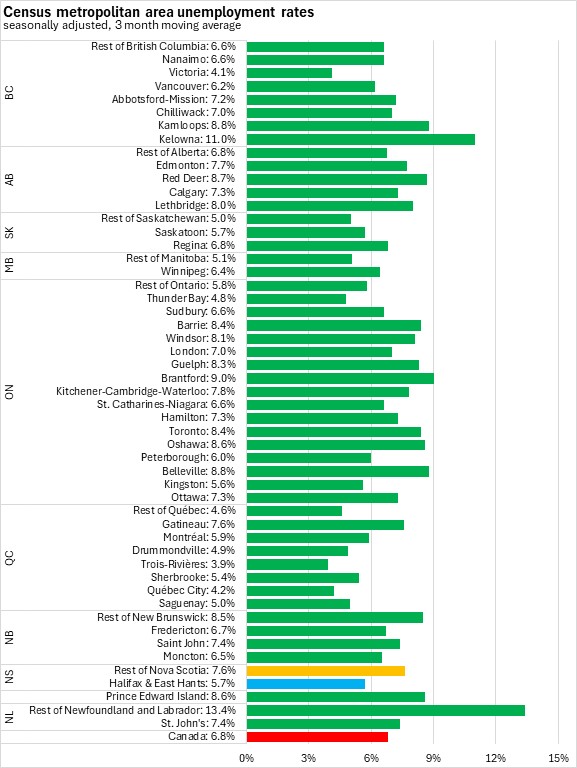
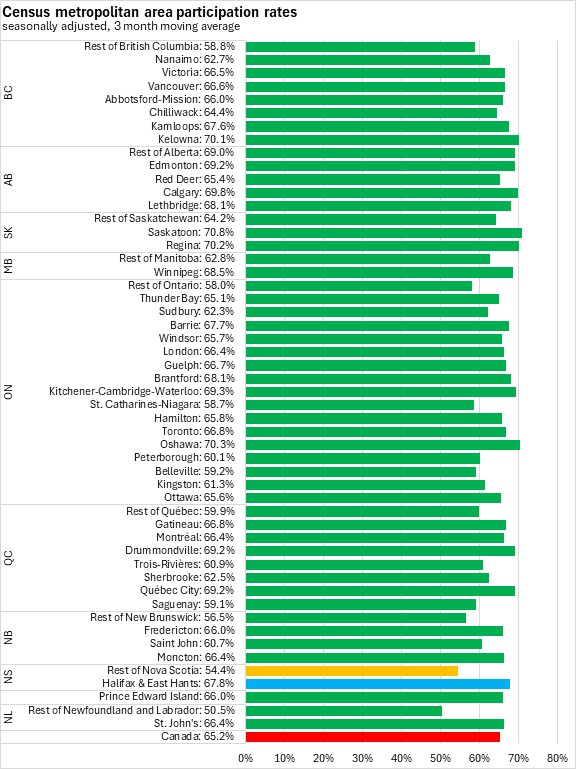
Halifax & East Hant's participation rate was 67.8% in the seasonally adjusted November 2025 three month moving average, while participation rates were 54.4% across the rest of the province.
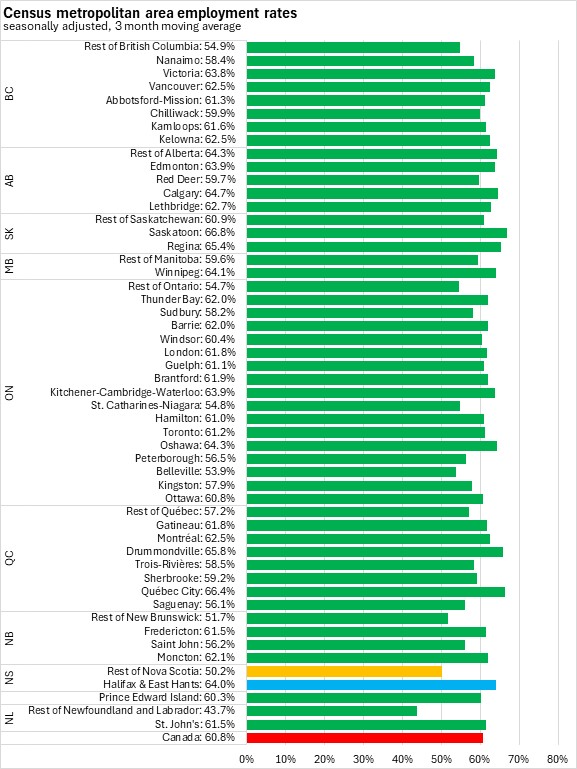
Halifax & East Hants reported an employment rate of 64.0% in the seasonally adjusted November 2025 three month moving average, while the employment rate was 50.2% outside the city.
Sources: Statistics Canada. Table 14-10-0036-01 Actual hours worked by industry, monthly, unadjusted for seasonality; Table 14-10-0063-01 Employee wages by industry, monthly, unadjusted for seasonality; Table 14-10-0287-01 Labour force characteristics, monthly, seasonally adjusted and trend-cycle, last 5 months; Table 14-10-0380-01 Labour force characteristics, three-month moving average, seasonally adjusted; Table 14-10-0387-01 Labour force characteristics, three-month moving average, unadjusted for seasonality, last 5 months; Table 14-10-0355-01 Employment by industry, monthly, seasonally adjusted and unadjusted, and trend-cycle, last 5 months (x 1,000); Table 14-10-0288-01 Employment by class of worker, monthly, seasonally adjusted and unadjusted, last 5 months (x 1,000); Table: 14-10-0459-01 Labour force characteristics, three month moving average, seasonally adjusted (x 1,000)