For additional information relating to this article, please contact:
December 15, 2025NEW VEHICLE REGISTRATIONS, Q3 2025 Statistics Canada now reports Nova Scotia results for new motor vehicle registrations. Data are reported for all provinces except Newfoundland and Labrador and Alberta.
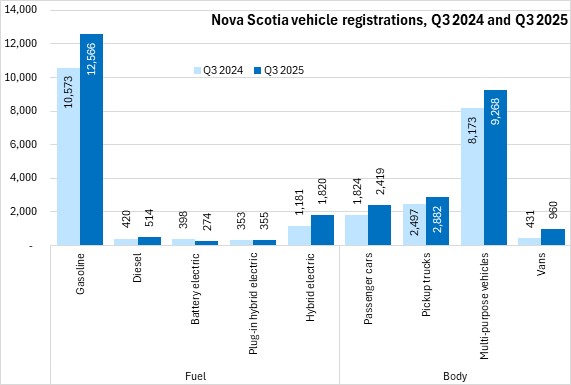
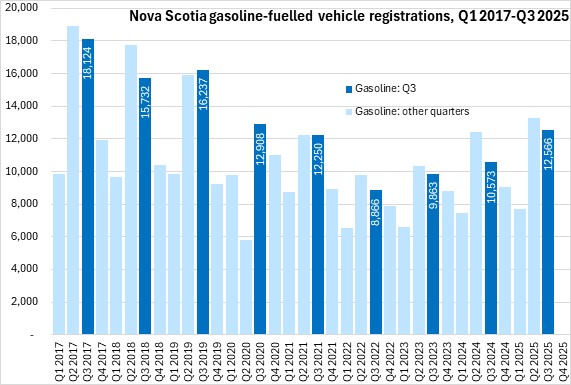
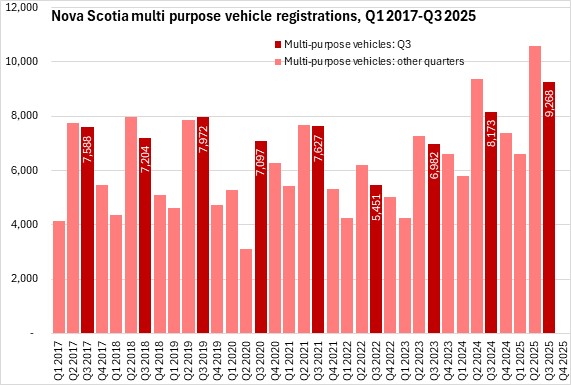
In Q3 2025, there were 15,529 new vehicles registered in Nova Scotia, up 20.1% from Q3 2024. Among fuel types, gasoline powered vehicles were the most common with 12,566 registrations - over 3 times the number of other fuel types registered (diesel, battery electric, hybrid and plug-in hybrid). Among body types, multi-purpose vehicles (including sport-utility vehicles) were by far the most common in Q3 2025 with 9,268 registrations.
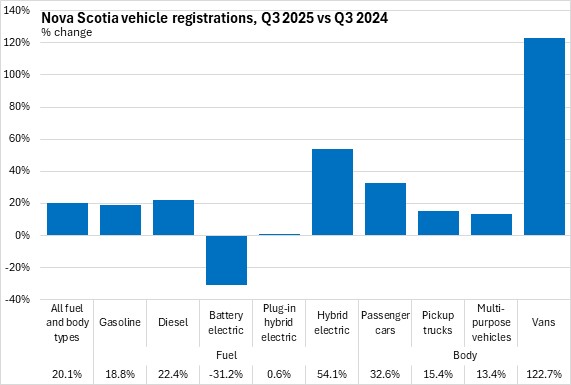
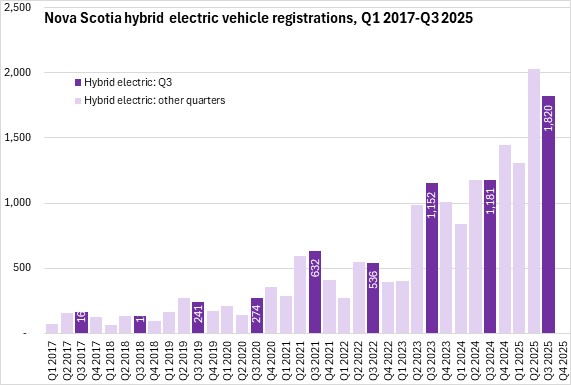
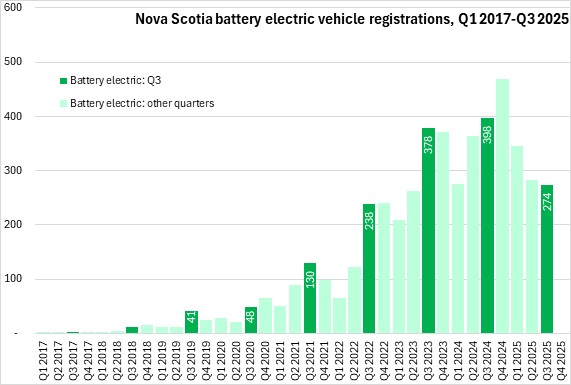
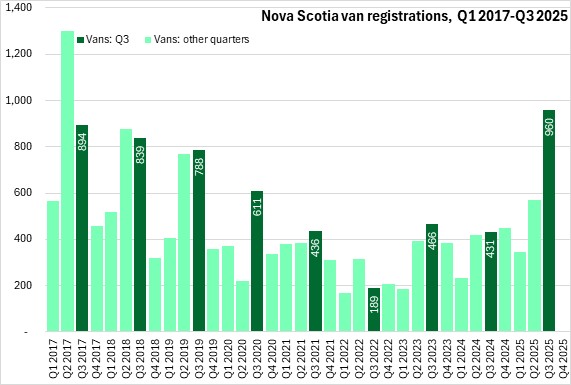
Registrations were up the most for hybrid-fuelled vehicles (+54.1%) in Q3 2025 while battery electric (-31.2%) reported lower registrations than in Q3 2024. Among body types, registrations were up most for vans (+122.7% - though this started from a relatively low value). Registrations were up for all other body types in Nova Scotia from Q3 2024 to Q3 2025.
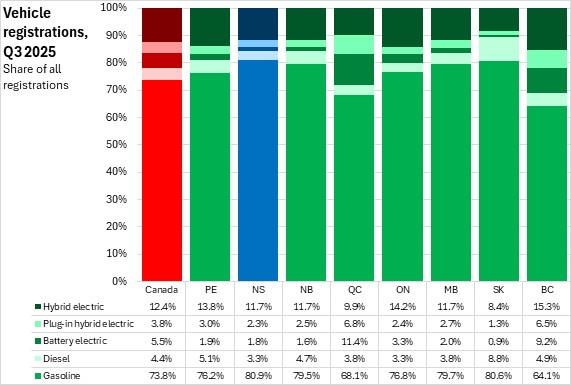
In Q3 2025, 80.9% of Nova Scotia's vehicle registrations were for gasoline-fuelled vehicles - the highest such share among provinces. Nationally, gasoline-fuelled vehicles were 73.8% of registrations in Q3 2025. British Columbia and Québec had the lowest shares of gasoline-fuelled vehicles among Q3 2025 registrations. Hybrid and plug-in hybrid vehicles were more commonly registered in British Columbia while Québec had the highest share of battery electric vehicles in its Q3 2025 registrations. Diesel vehicles were a larger share of registrations in Alberta.
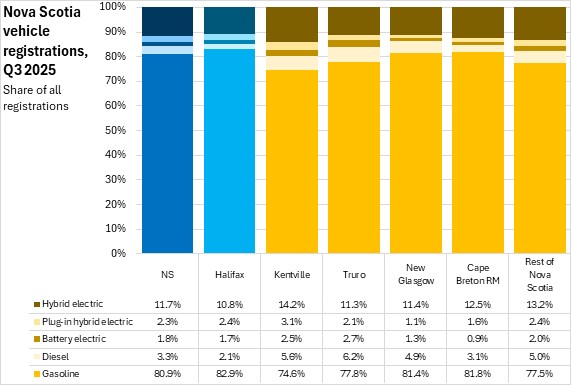
Across Nova Scotia, gasoline-fuelled vehicles were the majority of registrations in all areas in Q3 2025. Gasoline-fuelled vehicle registrations were more prevalent in Halifax, followed by Cape Breton Regional Municipality and New Glasgow. Battery electric vehicles were more commonly registered in Truro and Kentville while hybrid electric were more commonly registered in Kentville. Diesel-fuelled vehicles were more commonly-registered in Truro.
Trends
Vehicle registrations exhibit seasonal patterns, with Q3 registrations typically falling compared to the quarter before for most engine and body types.
Although they are still the most commonly-registered fuel type in Nova Scotia, gasoline-fuelled vehicle registrations have declined and remain below levels from before 2020. However, there has been a small rise in Q3 registration of new gasoline-fuelled vehicles since 2022.
Hybrid electric vehicle registrations have risen sharply in the last two years - making them the second most common type vehicle propulsion registered in Nova Scotia in Q3 2025.
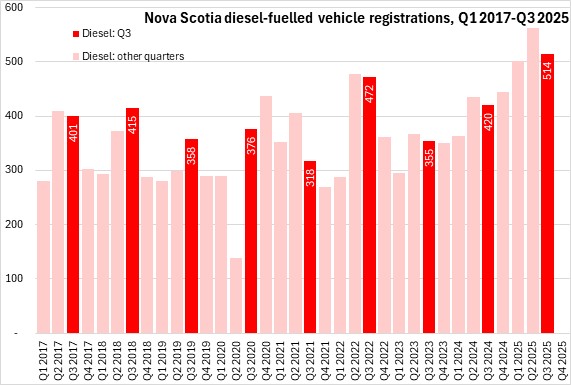
Diesel-fuelled vehicles have reported higher registrations since 2023, but remain substantially less than the number of hybrid electric registrations.
Battery electric vehicle registrations accelerated sharply from 2021 to 2024, but declined (year-over-year) in the last quarter.
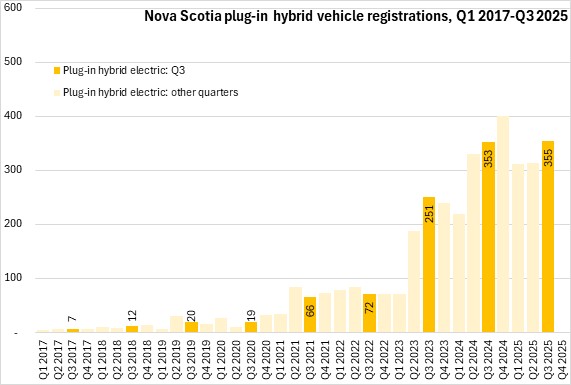
Plug in hybrid registrations remain largely at the same level in Q3 2025 compared to the year prior.
Multi-purpose vehicles such as sport-utility vehicles remain by far the most commonly-registered new vehicles in Nova Scotia, particularly in the last year.
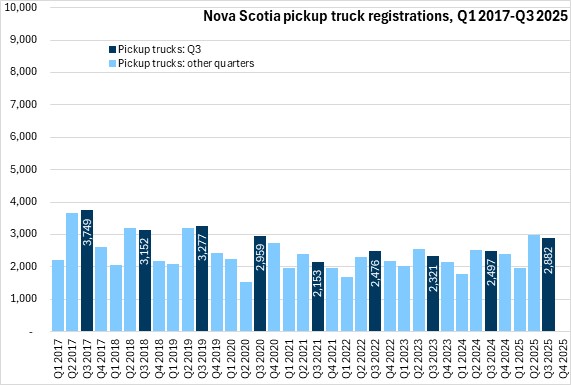
Pickup truck registrations were up in the last year.
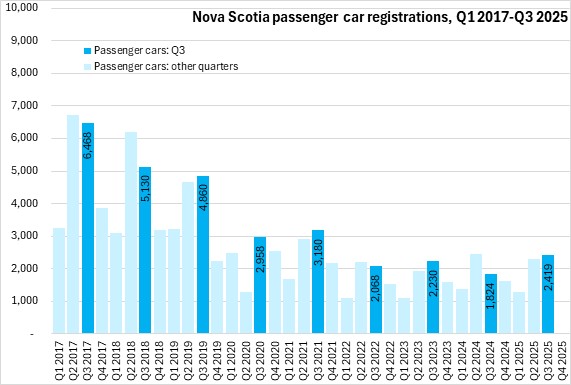
Registration of new passenger cars remains substantially lower than it was prior to 2020, despite increasing year-over-year in Q3 2025.
Although registration of new vans declined sharply in 2022-2024, there was a sharp increase in Q3 2025.
Source: Statistics Canada. Table 20-10-0025-01 New motor vehicle registrations, quarterly, by geographic level