For additional information relating to this article, please contact:
January 30, 2026BUSINESS OPENING AND CLOSING, OCTOBER 2025 Monthly (October 2025 vs September 2025, seasonally adjusted)
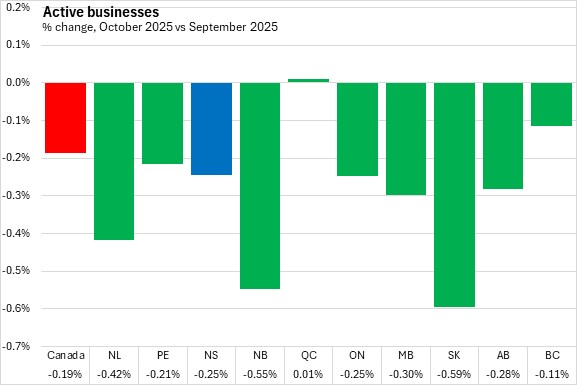
The number of active businesses in Nova Scotia dropped by 0.25% from September 2025 to October 2025, falling by 52 to 21,139 active businesses.
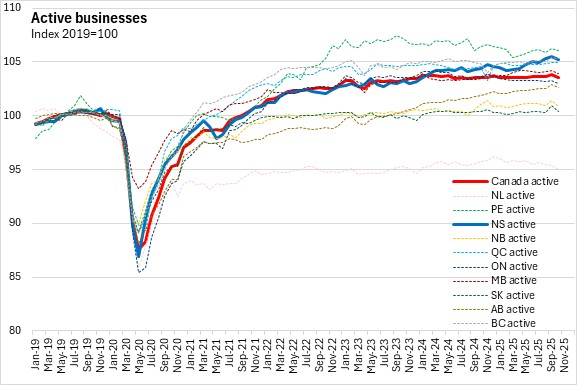
Nationally, active businesses were down 0.19%, with declines in all provinces except Québec. Saskatchewan and New Brunswick reported the fastest declines in active businesses.
A business will be classified as 'opening' if it had no employment in the previous month and then has employment in the next month. A business is 'closing' if it had employment in the previous month and no employment in the current month. For opening and closing, the reason could be a permanent change (i.e. business exit) or temporary for reasons such as seasonal operations, capital maintenance or restructuring. Continuing business are those that had employment in both the current and previous month. Active businesses are the sum of continuing and opening business in the current month.
The rate at which business either opened, continued or closed can be examined to see how the number of active businesses has changed. The calculation for the opening, continuing and closure rates are based on the number of active businesses in the previous month.
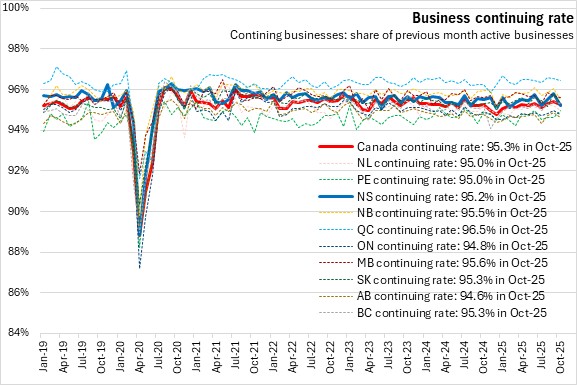
Most businesses continue operating each month. In October 2025, Nova Scotia's business continuing rate was 95.2%, slightly below the national average (95.3%). Québec reported the highest business continuing rate (96.5%) while Alberta reported the lowest continuing rate (94.6%).
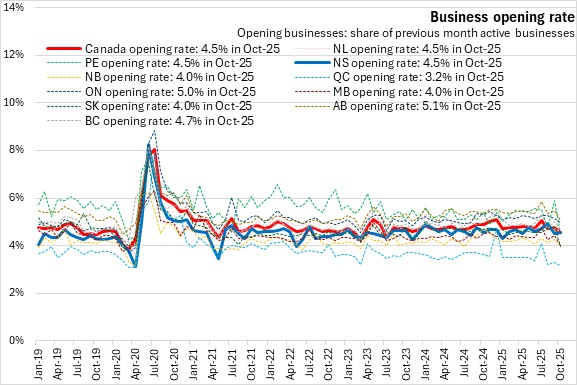
Nova Scotia's business opening rate was 4.5% (same as the national rate) in October 2025, slightly up from the previous month. Alberta had the highest business opening rate (5.1%) while Québec had the lowest (3.2%).
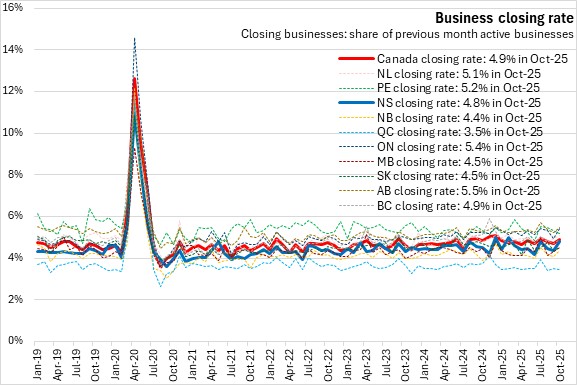
Nova Scotia's business closing rate was 4.8% in October 2025, below the national average of 4.9%. Alberta reported the highest business closing rate (5.5%), while Québec had the lowest business closing rate (3.5%).
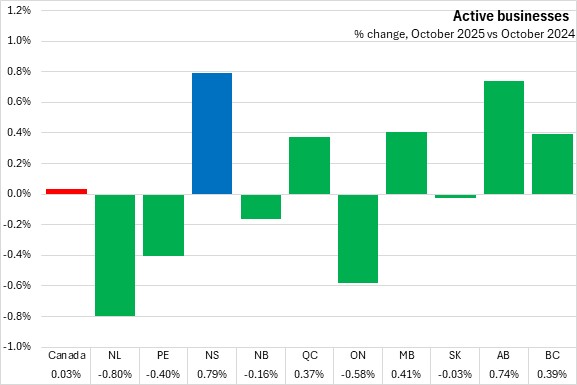
Year-over-year (October 2025 vs October 2024)
Compared with October 2024, the number of active businesses was up 0.79% for Nova Scotia, the largest increase among provinces. Nationally, active businesses edged up 0.03% compared to October 2024. Newfoundland and Labrador reported the fastest year-over-year decline in active businesses.
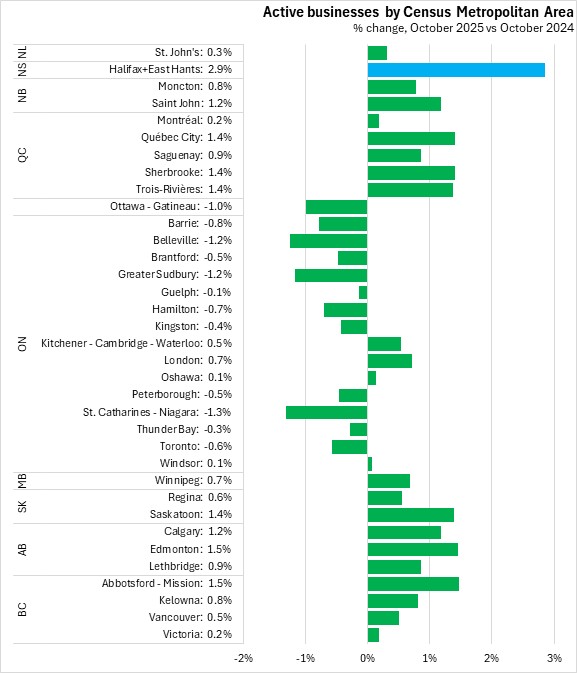
The number of active businesses in the Halifax and East Hants Census Metropolitan Area was up 2.9% from October 2024 to October 2025, the fastest rise among Census Metropolitan Areas (CMA).
Out of 35 CMAs, 23 reported growth in active businesses over the past 12 months. St. Catharines-Niagara, Greater Sudbury, and Belleville reported the largest declines.
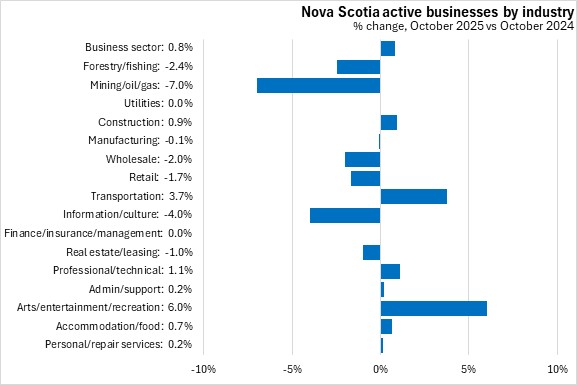
Compared with October 2024, seven sectors saw an increase in active businesses in Nova Scotia in October 2025 with the largest percentage increase in arts/entertainment/recreation. The steepest decline was in mining/oil/gas. Utilities and finance/insurance/management active businesses were unchanged.
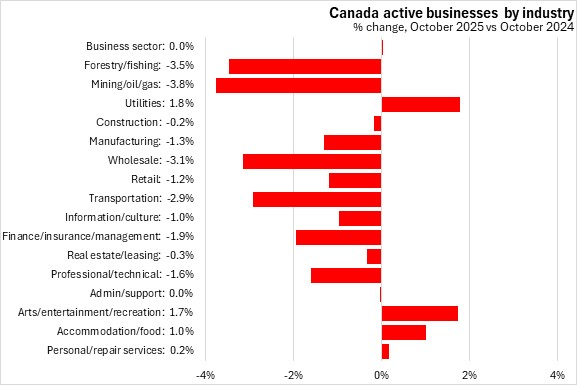
Nationally, the number of active businesses was down for twelve of sixteen business sectors. The largest gain was in utilities, while the largest decline was in mining/oil/gas.
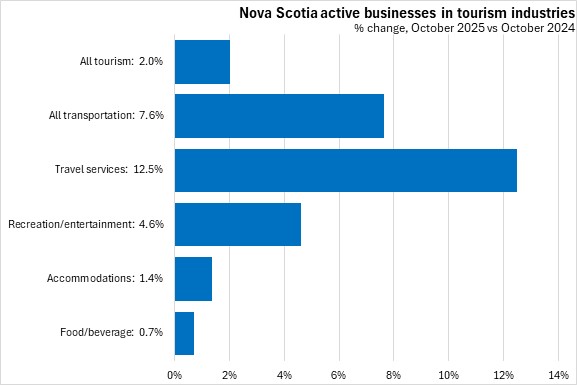
Statistics Canada has broken out specific data for tourism-related industries. Compared with October 2024, the number of active tourism-related businesses increased 2.0% in Nova Scotia as of October 2025, with gains in all subsectors (fastest: travel services).
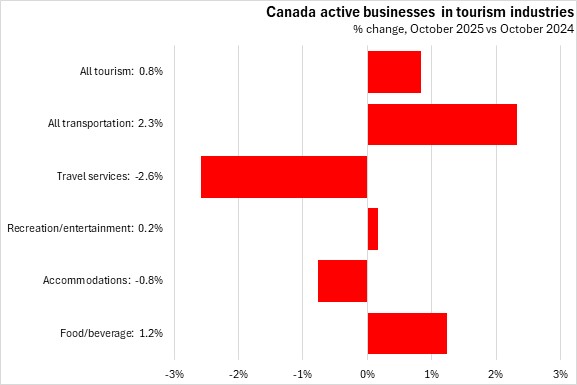
Nationally the number of tourism-related businesses was up 0.8% from October 2024 to October 2025, with transportation, recreation/entertainment, and food/beverage gains offsetting a decline in travel services and accommodations.
Trends
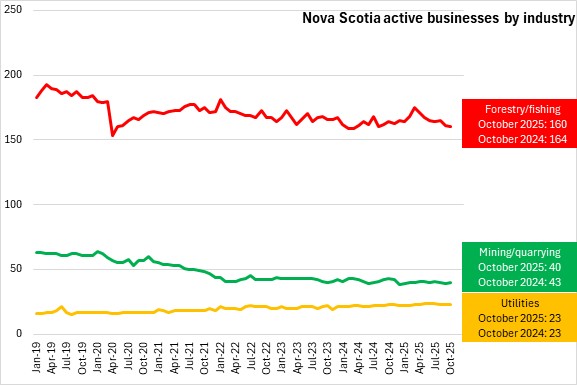
There has been a downward trend in forestry/fishing active businesses, but in the three months prior to April there was a substantial rise in active businesses. Active businesses in forestry/fishing subsequently declined up to October from their recent peak in March 2025. Mining/quarrying has been steadily declining. Utilities had been slowly growing but reported little change in recent months.
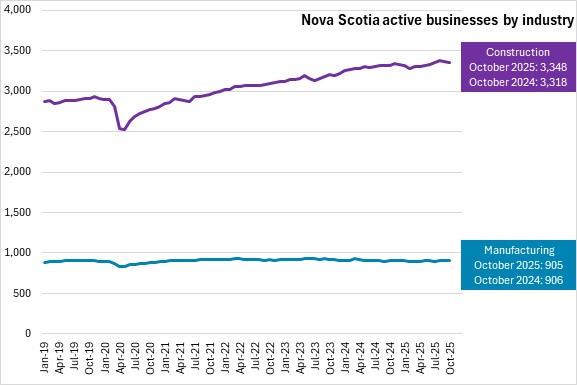
From 2020-2025, the number of active businesses in construction grew at a steady pace with a slight dip in the end of 2024 and in recent months. Manufacturing businesses have remained stable for the past 3 years.
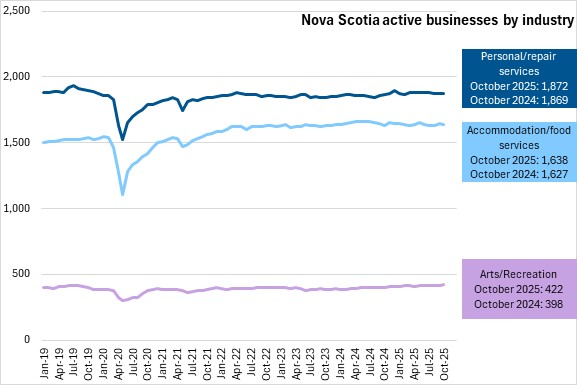
There have been small decline in active businesses for personal/repair businesses in the recent months, and small gains in accommodation/food services. Arts/recreation business counts have changed little in recent months.
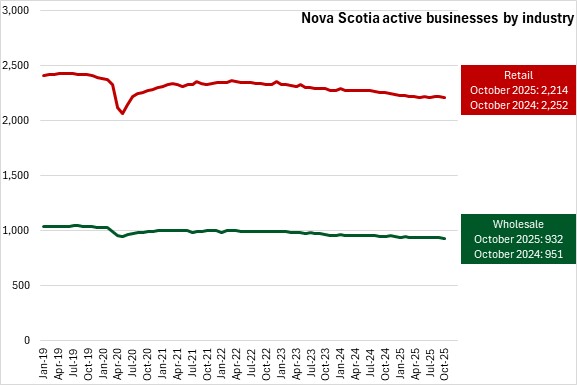
Retail and wholesale businesses have declined in the past two years, but have stabilized in recent months.
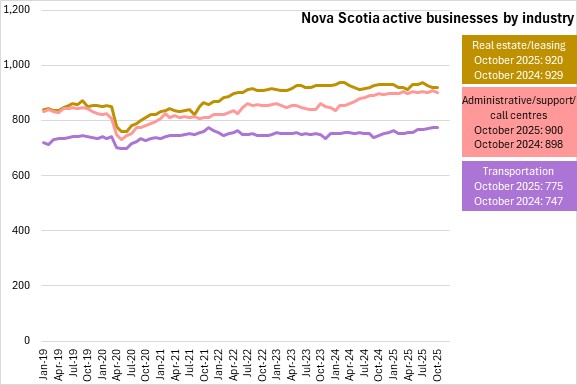
Active businesses in transportation have been rising slowly since early 2025. The number of active businesses in real estate/leasing have declined again after recent growth. Active businesses in administrative/support/call centers have grown since 2024.
Professional/technical services active businesses have grown in 2025, but this growth tapered off in the most recent months. Finance/insurance/management businesses as well as businesses in information/culture have been stable.
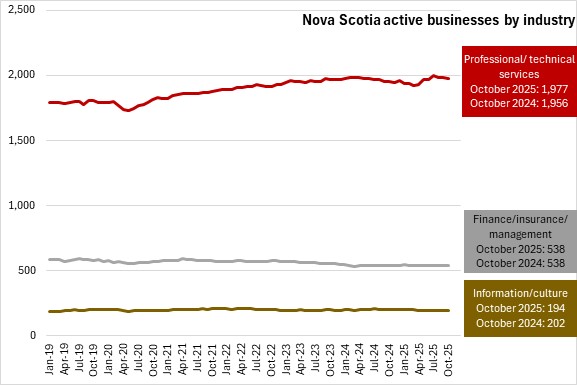
The source data is seasonally adjusted. The data may not aggregate due to firms being classified into multiple industry or geography.
Source: Statistics Canada. Table 33-10-0270-01 Experimental estimates for business openings and closures for Canada, provinces and territories, census metropolitan areas; Methodology: Business Opening and Closing