For additional information relating to this article, please contact:
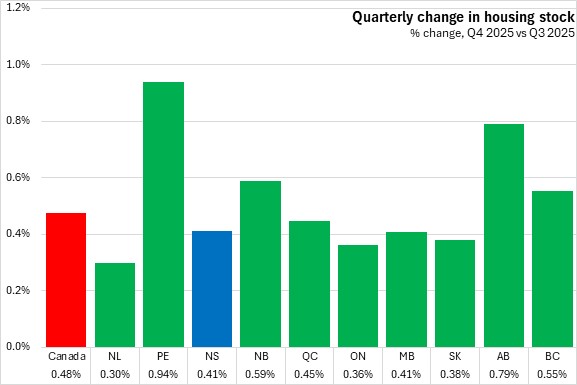
February 27, 2026HOUSING STOCK, Q4 2025 Quarter-over-quarter (Q4 2025 vs Q3 2025)
As of Q4 2025, Nova Scotia had a housing stock of 502,146 units, up 0.41% from Q3 2025. Nationally, housing stock was 17,429,535 units, up 0.48% from Q3 2025. All provinces reported a rise in housing stock, with the fastest gain in Prince Edward Island. The slowest gain was reported in Newfoundland and Labrador.
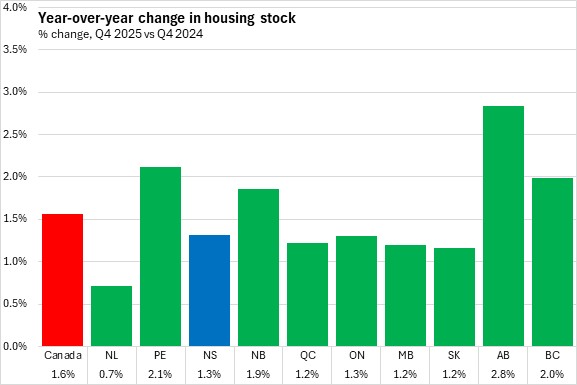
Year-over-year (Q4 2025 vs Q4 2024)
Compared with Q4 2024, Nova Scotia's housing stock has grown by 1.3%. National housing stock has grown by 1.6% with gains in all provinces, led by Alberta. Newfoundland and Labrador lagged the other provinces in housing stock growth.
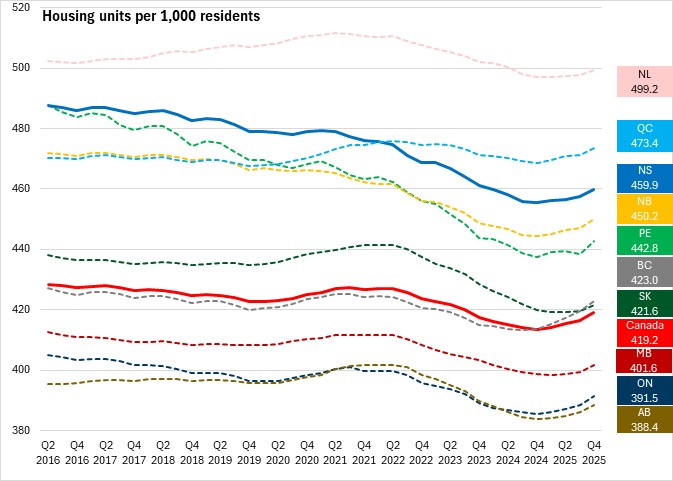
Trends
Nova Scotia's housing stock amounts to 459.9 units per 1,000 residents. Although this is the third highest among provinces (after Newfoundland and Labrador and Québec), Nova Scotia's stock of housing has grown more slowly than the population. This had resulted in falling units per 1,000 residents in the province, particularly since 2020. However, housing stock per 1,000 residents has been growing since the end of 2024.
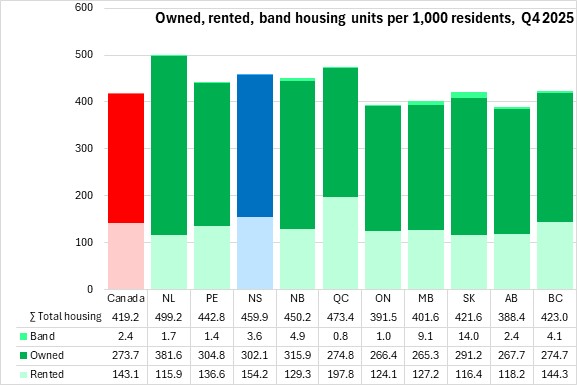
Composition of housing stock
Nova Scotia's housing stock includes 302.1 units per 1,000 residents of owned stock, 154.2 units per 1,000 residents of rented stock and 3.6 units per 1,000 residents in band housing stock.
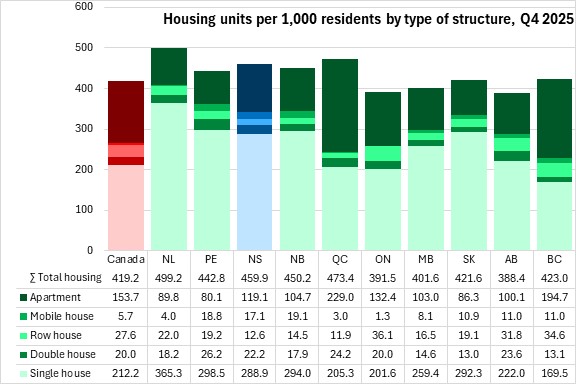
Compared with national averages, Nova Scotia's housing stock consists more of single houses (288.9 units per 1,000 residents) and less of apartments (119.1 units per 1,000 residents). Nova Scotia also has more mobile homes per 1,000 residents than the national average, though this is only 3.7% of the province's housing stock. Newfoundland and Labrador reported the highest stock of single houses per 1,000 residents while Québec reported the highest stock of apartments per 1,000 residents.
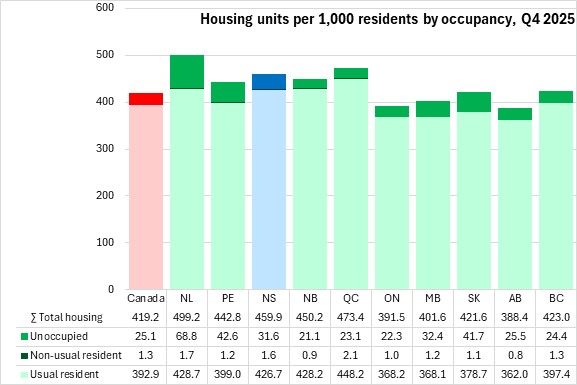
The overwhelming majority of housing units are occupied by a usual occupant (92.8% in Nova Scotia, 93.7% in Canada). A further 6.9% of units in Nova Scotia were unoccupied (6.0% nationally). Only a small portion of housing units were occupied, but not by a usual occupant.
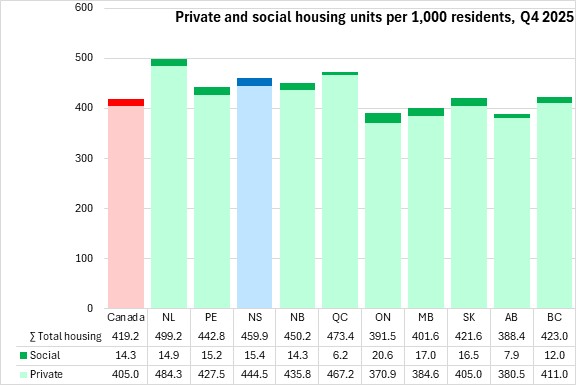
Privately-held housing amounted to 96.7% of Nova Scotia's housing stock (96.6% nationally). Nova Scotia did report more units of social housing stock per 1,000 residents than the national average.
Source: Statistics Canada. Table 36-10-0688-01 Housing stock in unit by institutional sector, housing type, dwelling occupation, dwelling type, and tenure type; Table 17-10-0009-01 Population estimates, quarterly