For additional information relating to this article, please contact:
July 13, 2026STUDY: INDIVIDUAL AND INSTITUTIONAL INVESTORS IN THE CANADIAN HOUSING MARKET Statistics Canada has recently released a study on the role of investors in the Canadian residential housing market. Over the past few decades, property prices and rents have risen rapidly as the rate of owner households declined from 69.0% in 2011 to 66.5% in 2021. This article presents an analysis of investors by size in order to analyze market concentration and better understand the role of investors in the residential housing markets of Prince Edward Island, Nova Scotia, New Brunswick, Ontario, Manitoba and British Columbia in 2022. Data comes from the Canadian Housing Statistics Program.
In this study, owners are classified as investors if they own at least one residential property which is not used as their principal residence (excluding non-profit organizations). Personal use investors are individuals buying an investment property for their own or their family's enjoyment, while both individuals and businesses may be considered small-scale (up to five properties), or medium-scale (five or more properties) investors. Institutional investors are owners (businesses or individuals) who make up the top 0.1% of investors by assessed value.
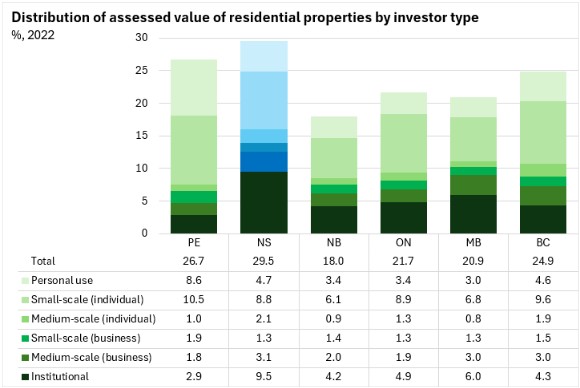
Nova Scotia had notably higher rates of investor ownership as a share of assessment values (29.5%), particularly for institutional investors (9.5%). New Brunswick had notably lower rates of overall investor ownership by share of assessment value (18.0%), while Prine Edward Island had the lowest rates of institutional ownership by share of assessment value (2.9%). Personal use (8.6%) and small-scale individual (10.5%) ownership rates were highest in Prince Edward Island.
Across Canada, institutional investors were much less active in buying and owning individual houses, with ownership rates ranging from 0.1%-0.4% in provinces for which data was available. Of the single-family homes that were investments, the majority were owned by small scale individual investors or those investing for personal use.
Institutional investors are much more active in the rental housing market, particularly in Nova Scotia.
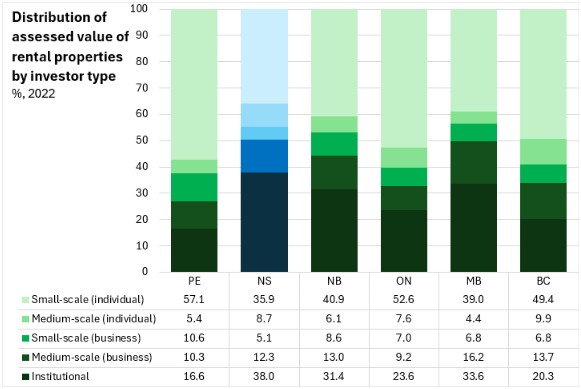
While the largest proportion of the rental housing market was owned by small-scale (individual) investors in most provinces, in Nova Scotia institutional investors made up the largest proportion of the rental housing market with 38.0% of the assessed value. Prince Edward Island had the lowest proportion of institutional investors at 16.6%. Small-scale individual investor ownership was highest in Prince Edward Island (57.1%) and lowest in Nova Scotia (35.9%).
Institutional investors were found to own larger shares of more recently constructed rental properties in every province except Prince Edward Island and Ontario.
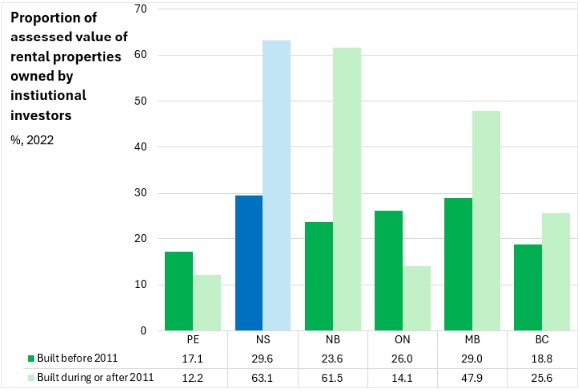
Institutional investor ownership of recently constructed (built on or after 2011) rental properties was highest in Nova Scotia (63.1%) and lowest in Prince Edward Island (12.2%). The largest difference in institutional investor ownership of new vs older rental properties was in New Brunswick (+37.9 percentage points) and Nova Scotia (+33.5 percentage points).
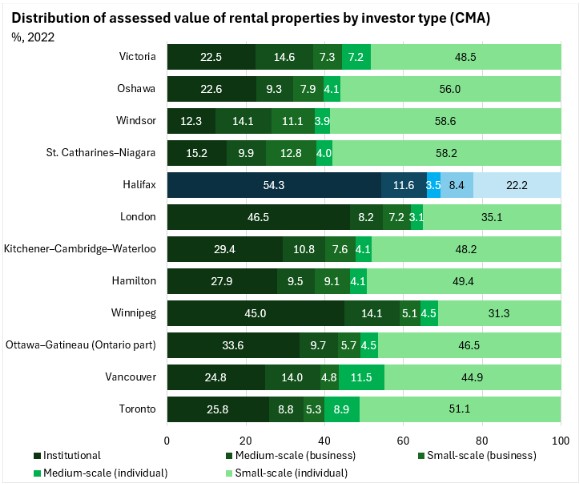
The share of rental property values owned by institutional investors was more than 40% in 3 of the 12 CMAs analyzed: Winnipeg (45.0%), London (46.5%) and Halifax (54.3%). Small-scale individual investor ownership was most common in 9 of the 12 CMA’s analyzed, with Windsor (58.6%) having the highest proportion.
Finally, the study uses the Herfindahl-Hirschman Index (HHI) to analyze whether the degree of investor concentration in the 12 CMA’s analyzed is resulting in uncompetitive rental markets. The HHI ranges from 0 to 10,000, with values under 1,500 generally considered consistent with non-concentrated markets, and values over 2,500 representing highly concentrated markets. When analyzing the 12 CMA’s for which data was available, London, Ontario was found to have the highest HHI at 133.9, followed by Halifax, Nova Scotia (80.2). By this metric, the CMAs with the highest degrees of market concentration fell well short of the threshold where non-competitive rental markets would become a concern.
Statistics Canada: Individual and institutional investors in the Canadian housing market
Statistics Canada: Canadian Housing Statistics Program, 2022