
Meet the 2026 Winners: Woodland Owner of the Year
Meet the 2026 Winners: Woodland Owner of the Year
Western Region and Provincial Winners
The western region and provincial winners of the 2026 Woodland Owner of the Year Award is Ross and Carla Pentz of Hebbs Cross, Lunenburg County. 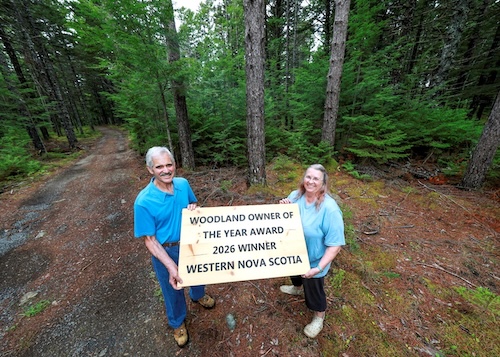
Ross has owned this family woodlot for 50 years and has carried on the family's heritage and tradition of sustainably managing this highly productive land.
Being a Forest Technician and working with the Department of Natural Resources gave Ross both the knowledge and desire to do the right things with this woodlot. Ross had a Forest Management Plan prepared in 1979 (recently updated) by the Department of Natural Resources and has religiously followed that early plan. Ross has carried out the prescribed silviculture treatments and carried out any harvesting of mature trees with a soft touch.
The Pentz family has always been kind, and their woodlot has always been open to neighbours and friends for recreational activities such as horseback riding, bird watching and hiking.
Ross has always done all the woodlot work himself, which has truly been a labour of love. Now after his 50 years of careful management, Ross has undertaken a significant commitment of signing up with the Nova Scotia Working Woodland Trust and his new management plan is considerably different from the one that was prepared in 1979 but the underlying principles are still the same: "work with nature to enhance and improve his woodlot for the future".
Eastern Region Winners
The eastern region winners of the 2026 Woodlot Owner of the Year Award are Bill Angevine and family of Antigonish County.
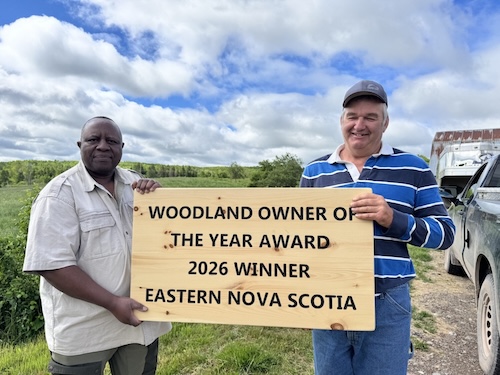
Bill Angevine has demonstrated a deep and sustained commitment to responsible woodland stewardship through thoughtful management practices, continuous learning and a strong ethic of environmental and sustainable resource management.
His approach to woodland ownership reflects both practical forestry knowledge and genuine dedication to improving the long-term ecological and economic value of his land. Bill purchased his woodlot in 2006. The property contains stands harvested between 2001 and 2006, as well as evidence of older harvesting dating back to the 1960s.
Since acquiring the land, Bill has invested significant effort into improving the productivity, accessibility, and overall health of the woodland. He is currently interested in developing a formal management plan to continue guiding the future stewardship of the property and ensuring the sustainability of the forest for future generations.
Over the years, extensive silviculture work has been completed on the property, including planting, pre-commercial thinning (PCT), early competition control (ECC), crop tree release, and selection management. These activities demonstrate Bill's long-term commitment to active woodland management and his willingness to invest both time and resources into improving forest conditions.
Bill has extensive experience with horse logging and has harvested softwood stud wood and pulpwood on neighbouring properties within a 30-minute radius of his farm. He plans to continue using horse logging methods to selectively harvest mature fir from his own woodlot over the next decade. This low-impact approach minimizes soil disturbance and reflects Bill's careful balance between forest utilization and environmental stewardship. He has also improved the condition and accessibility of the woodland through the construction of roads that now provide excellent access throughout the property.
In addition, Bill operates a bandsaw mill, demonstrating his hands-on involvement and interest in utilizing local forest resources responsibly and efficiently. One of the most notable aspects of Bill's management philosophy is his use of integrated resource management principles. He has intentionally left some areas untreated by PCT in order to stagger stand development and create a diversity of forest ages and structures across the property. One stand consists of approximately 30 acres of 25-year-old poplar and balsam fir, which Bill hopes to gradually transition toward greater species diversity. His goal is to promote a more resilient woodland capable of withstanding future pest pressures and environmental challenges.
Bill has also undertaken salvage harvesting in recent years and is exploring the possibility of small-scale Christmas tree production on some of the salvage sites. This reflects both adaptability and a willingness to pursue sustainable opportunities that complement the long-term health and productivity of the woodland. Wildlife habitat protection remains an important consideration in Bill's stewardship. Near the house, a crow's nest was occupied by nesting eagles for several years, and Bill has remained mindful of preserving the habitat values associated with the property. In 2026, Bill Angevine was also a recipient of the Forest Stewardship Certificate presented by Minister Masland in recognition of his outstanding leadership across the forestry industry. This recognition reflects the respect Bill has earned for his commitment to sustainable forestry practices and his positive contributions to woodland stewardship in Nova Scotia. Bill Angevine exemplifies the qualities the Woodland Owner of the Year Award was created to recognize dedication, practical stewardship, continuous improvement, and a genuine respect for Nova Scotia forests. His commitment to sustainable woodland management and responsible resource use makes him an outstanding woodland owner.